


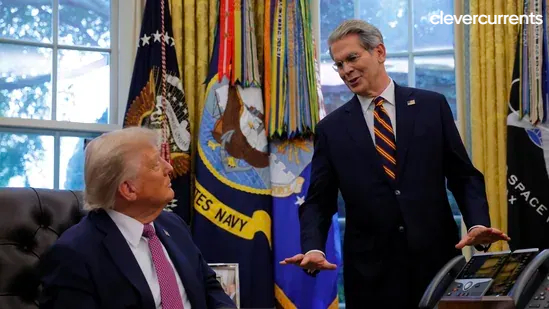
In November 2025, the U.S. Treasury Secretary Scott Bessent publicly explained a new approach toward the H‑1B visa programme: the aim is to temporarily bring in skilled foreign workers to fill current gaps, train American workers, and then return to their home countries.
Key points:
-
This isn’t about permanent immigration or long-term replacement of American workers, according to the administration.
-
The focus is on industries where expertise is seen as lacking domestically — for example, advanced manufacturing, semiconductors, ship-building.
-
At the same time, the administration introduced a steep fee (US $100,000) on new H-1B visa applications to discourage “cheap foreign labour” and elevate the value of each admitted worker.
Why this shift? What’s driving it?
Several motivations appear behind the policy re-orientation:
1. Domestic labour concerns
The administration argues that many American workers cannot instantly step into highly specialised roles (e.g., precision manufacturing, semiconductors) without training, so short-term foreign experts are needed.
Also, there’s political pressure to “put Americans first” in job creation and wages — a theme central to Trump’s platform.
2. Strategic industries & national competitiveness
With manufacturing having been off-shored and certain capabilities weakened, there’s a strategic push to rebuild U.S. industrial capacity (e.g., bringing semiconductors back). Skilled immigrants are viewed as a bridge in this process.
3. Controlling immigration while still accessing talent
Rather than relying on long-term foreign labour, the idea is to make the programme more circumscribed, transient, and oriented toward knowledge transfer rather than substitution. The high fee and tighter scrutiny act as mechanisms to trim utilisation.
What are the implications?
For foreign workers (especially from India, etc)
-
The role of H-1B-type skilled workers is being reframed: fewer long-term stays, more short-term expert engagements.
-
The increased cost and regulatory burden may reduce the number of H-1B visas granted or deter companies from sponsoring.
-
Countries that traditionally sent large numbers of H-1B workers (e.g., India) may be impacted by reduced demand.
For U.S. employers & industries
-
Firms relying on foreign talent will face higher costs and more scrutiny.
-
They may be required to emphasise training/transferring skills to American workers.
-
Long-term talent pipelines may shift — companies might invest more in domestic training or look for alternatives (off-shoring again, or other visa categories).
For American workers & the labour market
-
There may be increased focus on up-skilling U.S. workers to fill high-skill roles previously filled by foreign workers.
-
The policy could raise wage pressure in high-skill occupations (if fewer foreign workers are available or costlier).
-
However, if companies cannot find skilled domestic workers, there’s a risk of labour shortages or slower growth in tech/manufacturing sectors.
For international relations & global talent flows
-
Countries that send many H-1B workers may view this as a restrictive move, potentially straining workforce mobility.
-
Global companies might reconsider their U.S. investment or staffing plans if visas become harder or costlier.
-
The policy may shift the global movement of talent — away from the U.S., or toward pathways other than H-1B.
Criticisms and risks
-
Talent shortage: If the U.S. mis-gauges how quickly domestic labour can be trained, industries might suffer from lack of qualified personnel.
-
Cost/benefit trade-off: The $100,000 fee (and broader regulatory burden) might discourage sponsors entirely, hurting both employers and economy.
-
Legal/backlash risk: Some of the changes (fees, caps) may face legal challenges or require congressional action.
-
Equity and fairness concerns: For workers already in the pipeline or who expected longer-term stays, the shift might feel abrupt or unfair.
-
Global competitiveness: If talent flows reduce, the U.S. might lose its edge in innovation if foreign experts choose other countries.
What’s next? What to monitor
-
Implementation details: How many visas will be approved under the new framework? Which firms/sectors will be prioritised?
-
Training metrics: Will there be clear targets for American workers being trained/“replaced” by foreign experts?
-
Impact on H-1B numbers: Annual cap is ~65,000 plus 20,000 for advanced degrees — will those caps change?
-
Response from industry: Will tech/manufacturing firms push back or adapt with different talent strategies?
-
Global reaction: Especially from countries supplying talent (India, China, others) and multinational firms.
-
Legal and legislative developments: Will Congress legislate changes, or will courts challenge the executive actions?
What this means for someone in India (or abroad) considering H-1B
-
Understand that the landscape is shifting: the “career long in the U.S.” model may become less reliable.
-
Focus may shift to short-term expert assignments, rather than long-term immigration.
-
Higher competition and higher cost for companies to sponsor foreign workers — may mean fewer opportunities or more selective criteria.
-
For those planning long-term careers in the U.S., explore alternate visa routes or domestic training pathways.
-
Stay updated on company policies: firms might change recruitment strategies, invest more in local talent, or reduce reliance on foreign sponsorship.
Conclusion: A recalibration, not a full stop
In essence, the new H-1B policy under Trump’s second-term vision appears to be a recalibration of high-skilled immigration: one that still recognises the need for global talent, but strongly emphasises temporary engagement, knowledge transfer, and American worker primacy.
Whether this will strike the right balance — between global competitiveness and domestic employment, between openness and control — remains to be seen. Industries, workers (domestic and foreign), and nations alike will be watching closely.