
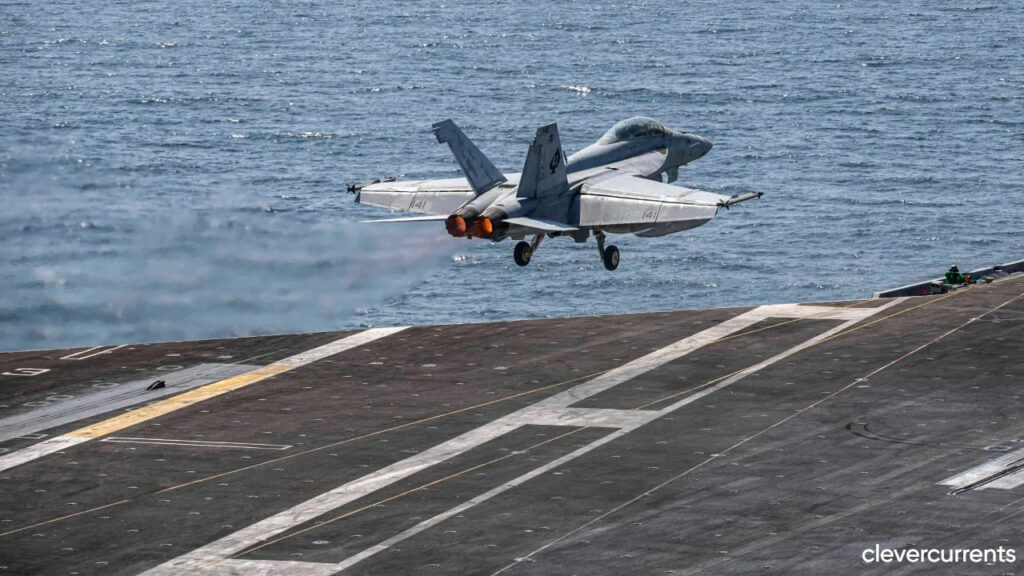
In late February–early March 2026, the United States launched one of the most significant coordinated military actions in recent history against Iran, code-named Operation Epic Fury. Within the first 24 hours, U.S. Central Command reported that an intense barrage hit over 1,000 targets across Iranian territory and military infrastructure.
This unprecedented operation mobilized a wide spectrum of America’s military firepower — from stealth bombers to fifth-generation fighters, drones, missiles, and naval strike groups.
✈️ Air Power: B-2 Bombers & F-35 Fighters Take Center Stage
B-2 Spirit Stealth Bombers
The U.S. Air Force deployed B-2 Spirit stealth bombers to strike deeply buried and hardened Iranian military targets, including ballistic missile sites and command facilities. These stealth aircraft — capable of penetrating advanced air defenses — carried heavy ordnance including large bunker-busting bombs.
F-35 & Other Fighter Jets
Alongside the B-2s, U.S. fighter aircraft played a crucial role:
-
F-35 stealth fighters provided precision strike capability and suppression of air defenses.
-
Additional U.S. fighters, including F-16s and F-22s, joined the campaign to establish air superiority and support bombing runs.
The combination of stealth and modern sensor networking allowed U.S. pilots to operate with relative freedom deep into Iranian airspace during the earliest stage of the campaign.
🚢 Naval Power: Supercarriers and Missile Strikes
Carrier Strike Groups
The U.S. fleet deployed at least two aircraft carrier strike groups near Iran’s maritime approaches, notably including the USS Abraham Lincoln (CVN-72) and the USS Gerald R. Ford (CVN-78). These carriers provided a sea-based platform for fighter jets and long-range strike missions.
From these ships and their accompanying escorts, the U.S. launched:
-
Tomahawk cruise missiles, capable of striking targets from hundreds of miles away.
-
Carrier-based fighters, including F-35Cs and F/A-18s, to support dynamic strikes over land.
These naval assets ensured that the U.S. could sustain pressure from the Gulf and Arabian Sea, even as air operations extended deep into Iranian territory.
🤖 Drones & Special Systems
The battlefield in Iran wasn’t limited to manned aircraft and ships — the Pentagon also used:
-
Suicide drones (LUCAS), one-way unmanned attack aircraft modeled on Iranian designs.
-
Electronic warfare and surveillance planes.
-
Missile defenses such as Patriot and THAAD to protect forces from Iranian counterattacks.
This blend of high-tech platforms underscored how modern warfare integrates both traditional and unmanned systems.
🌍 Strategic Implications of the First 24 Hours
The sheer scale of this deployment — heavy bombers, stealth fighters, drones, missile salvos and warships — sent a powerful message: the United States was prepared to leverage nearly its full suite of advanced military capabilities to curb Iran’s military and nuclear programs.
Analysts noted that this buildup was among the largest U.S. force concentrations in the Middle East in decades, reflecting both military resolve and geopolitical risk.
📌 Looking Ahead
While the first 24 hours established a dramatic operational footprint, the situation continues to evolve rapidly. Casualties — both military and civilian — along with diplomatic fallout and regional spillovers are all unfolding as world powers monitor the conflict.
What remains certain is that this campaign marks a watershed moment in 21st-century warfare — where stealth, precision, and overwhelming force converged in a brief but intense opening salvo.